
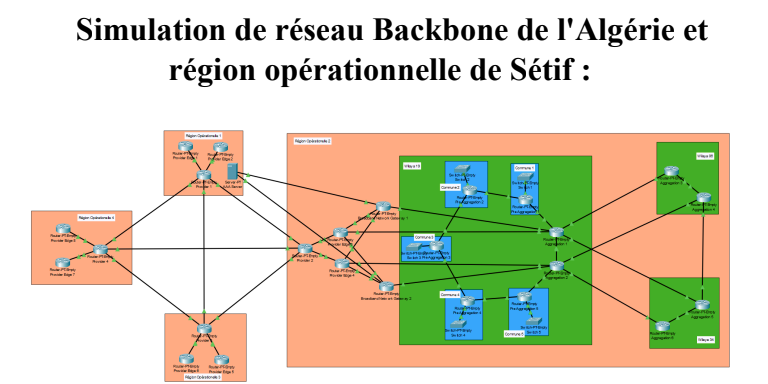
Advanced Simulation of Service Provider MPLS Backbone Network
The topology simulated a service provider core running IS-IS as the Interior Gateway Protocol and MPLS for label switching. Multiple customer sites were connected through Provider Edge (PE) routers using BGP MPLS. OSPF was deployed within customer networks, while MP-BGP distributed VPN routes across the backbone.
Enterprise networks require secure, scalable, and high-performance connectivity across multiple locations. Traditional routing approaches can lead to complexity, poor traffic prioritization, and limited scalability. The challenge was to build a provider-style MPLS backbone that isolates customer traffic while maintaining efficient routing and guaranteed performance for delay-sensitive applications.
An MPLS architecture was implemented using label switching across the provider core. MP-BGP handled VPN route exchange between PE routers, while QoS policies classified and prioritized traffic. Traffic flows were analyzed to ensure service differentiation and reliable connectivity under simulated congestion.
Key Technical Features
- MPLS Layer 3 VPN deployment with MP-BGP
- IS-IS routing protocol for provider core
- OSPF routing within customer sites
- QoS traffic classification and prioritization
- Label Distribution Protocol (LDP) for MPLS forwarding
- Simulation of enterprise multi-site connectivity